
Can Conversational Agents Change the Way Children Talk to People?
Proceedings of the 20th annual ACM conference on interaction design and children (IDC 2021).
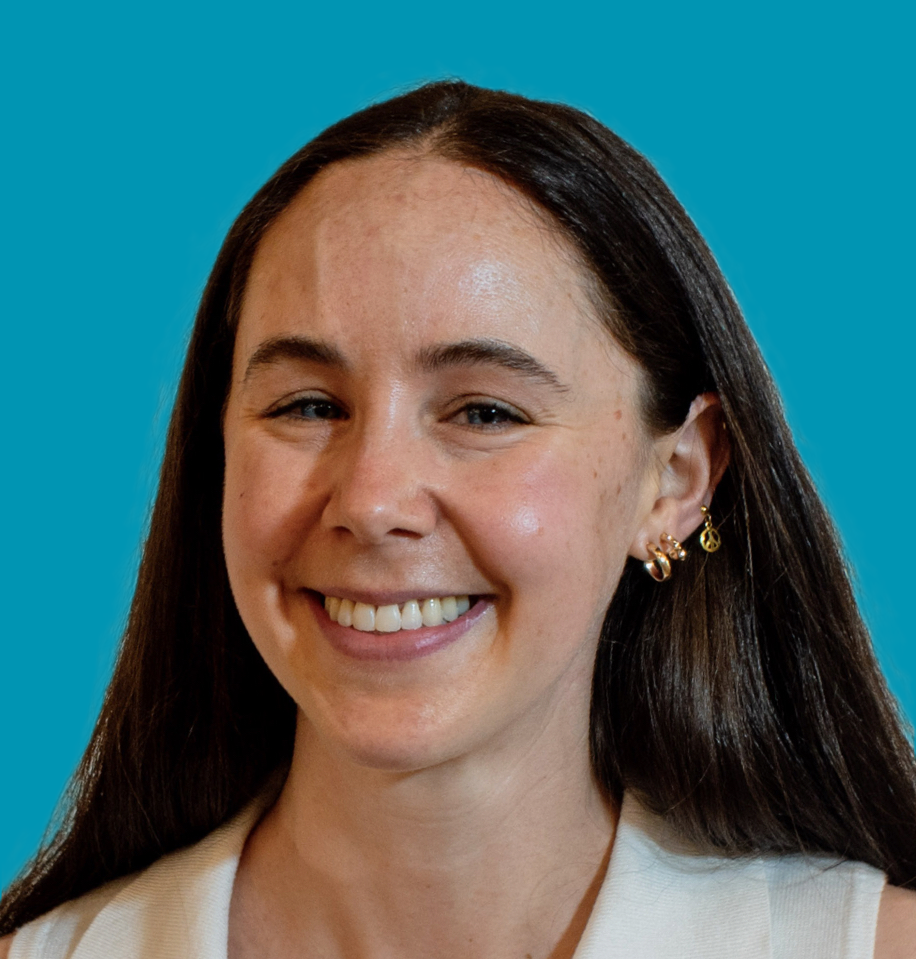
Kiley Sobel, PhD, is a Therapeutic Gaming and Digital Technology Specialist at Seattle Children’s Hospital who works directly with youth using video games, virtual reality, and other therapeutic technologies to enhance patient experiences and improve outcomes. Prior to joining Seattle Children’s, Kiley led the Product Research team at Duolingo. She also worked as a Research Scientist at the Joan Ganz Cooney Center, an independent research and innovation lab within Sesame Workshop, to advance positive futures for kids in the digital world. Throughout her career, Kiley has conducted research on children and families, co-design, collaborative play, learning, accessibility, and inclusion. She earned her PhD in Human Centered Design & Engineering from the University of Washington as a National Science Foundation Graduate Research Fellow and holds a BS in Human-Computer Interaction from Harvey Mudd College.
Proceedings of the 20th annual ACM conference on interaction design and children (IDC 2021).
Proceedings of the 18th annual ACM conference on interaction design and children (IDC 2019). Acceptance rate: 31%.
Proceedings of the 2019 ACM conference on human factors in computing systems (CHI ’19), 73:1-15. Acceptance rate: 23%.
Proceedings of the 18th Annual ACM Interaction Design and Children Conference (IDC 2017). Acceptance rate: 21%.
 Best paper honorable mention (top three papers)
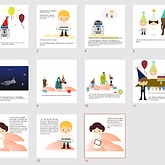
Proceedings of the 2017 ACM Conference on Human Factors in Computing Systems (CHI 2017). Acceptance rate: 25%.
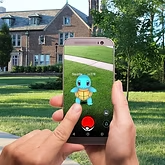
Proceedings of the 2017 ACM Conference on Human Factors in Computing Systems (CHI 2017). Acceptance rate: 25%.
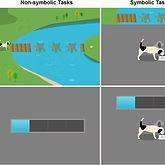
International Journal of Human Computer Studies (IJHCS), 90:53-67, 2016.
Proceedings of the 16th Annual ACM Interaction Design and Children Conference (IDC 2015). Acceptance rate: 23%.

Proceedings of the 2015 ACM Conference on Human Factors in Computing Systems (CHI 2015). Acceptance rate: 25%.