
SusBench: An Online Benchmark for Evaluating Dark Pattern Susceptibility of Computer-Use Agents
Proceedings of the 31st International Conference on Intelligent User Interfaces (IUI 2026). Acceptance rate: 20%.

Robert Wolfe is an Assistant Professor in the Rutgers iSchool, where his research focuses on understanding and improving the reliability of general-purpose AI models. Wolfe received his Ph.D. in Information Science from the University of Washington for his work on epistemic risks in generative and general-purpose AI. He previously earned Master’s degrees in Computer Science, Information Science, and English Literature. Wolfe’s ongoing work studies evolving privacy norms around chatbots, applications of AI in high-stakes information work, and uses of AI on social media. His recent collaborations on topics including privacy attacks on large language models, calibration methods for general-purpose AI, justice-oriented neighborhood technologies, trust-building approaches on social media, and novel approaches to AI literacy have been published in venues including ACM CHI, CSCW, SOUPS, ICML, ACL, and IDC.
Proceedings of the 31st International Conference on Intelligent User Interfaces (IUI 2026). Acceptance rate: 20%.

Proceedings of the ACM on Human-Computer Interaction (CSCW), 9(2):CSCW151, 2025.
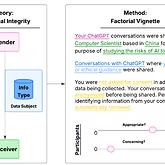
Proceedings of the 2025 AAAI/ACM Conference on AI, Ethics, and Society (AIES 2025). Acceptance rate: 32%.
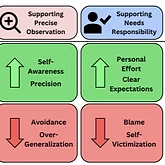
Proceedings of the 2025 AAAI/ACM Conference on AI, Ethics, and Society (AIES 2025). Acceptance rate: 32%.
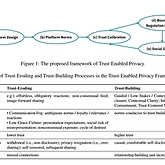
Proceedings of the 21st Symposium on Usable Privacy and Security (SOUPS 2025).
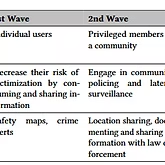
Proceedings of the 2025 ACM Conference on Human Factors in Computing Systems (CHI 2025). Acceptance rate: 25%.
 Best paper honorable mention (top 5%)

Proceedings of the ACM on Human-Computer Interaction (CSCW), 8(CSCW2):1-32, 2024.
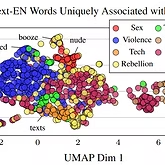
Proceedings of the 2024 AAAI/ACM Conference on AI, Ethics, and Society (AIES 2024). Acceptance rate: 38%.
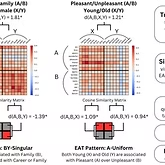
Proceedings of the 2024 AAAI/ACM Conference on AI, Ethics, and Society (AIES 2024). Acceptance rate: 38%.

Proceedings of the 2024 AAAI/ACM Conference on AI, Ethics, and Society (AIES 2024). Acceptance rate: 38%.